Some time ago we posted on our blog about one of our favorite items to sell, the 1893 New Zealand advertisement issues in reconstructed panes of 60. Here is a link to the Original Post. Just recently we have acquired two more panes which are currently on offer on our website. Both panes are very attractively mounted and labeled. Price $390 each. Take a look:
Philatelic Files
Two Rare Items Just Added!
We have just completed our regular update of the online price list with another interesting array of new material. These can all be found in our Recent Acquisitions list.
There are two items in particular that deserve special mention.
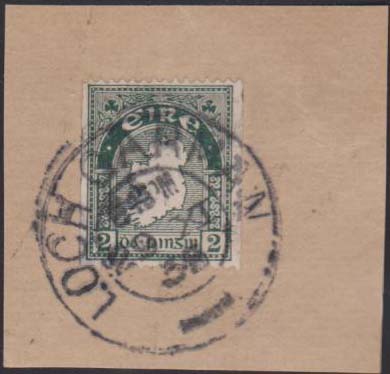
The first is an excellent opportunity for collectors of Ireland: a stunning example of the most difficult stamp of the country, the 1935 issue ‘Experimental Coil Stamp’ 2 Pence. This copy is used on piece with a clear 1935 Loch Garman C.D.S., and it comes with a MacDonnell Whyte certificate of authenticity.
References: Scott catalogue number 68b, Stanley Gibbons catalogue number 74b, MacDonnell Whyte D4cii.
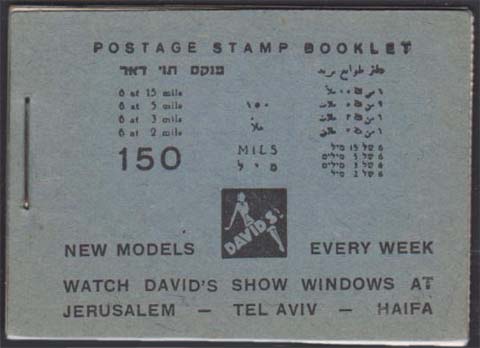
We would also like to draw attention to a newly acquired Palestine 1938 issue 150m Booklet, complete and unexploded. This is Stanley Gibbons number SB3a with Blue cover, and contents in English, Arabic, and Hebrew. We see the booklets of Palestine offered only rarely so we are pleased to have this very attractive example available for sale.
SOLD!
You can access our listings for both of these items directly from the Featured Items list on our Home Page.
Newfoundland Collectors Take Note
We are resurrecting the neglected blog to tell you about a fantastic item we have recently acquired. The limited space in our price list simply can not do justice to this exceptionally rare Newfoundland pane of 50 stamps. Here it is, with a full description below:
This partial pane shows the 1897 Queen Victoria era 1 cent on 3 cent issue, grey-purple, in 5 rows of 10 stamps. The complete setting is here: type I on rows 1-4, and the last row starting from left with one type IIa, seven copies of type II, and two copies of type III. The catalog numbers are Scott 75-77 and SG80-82. There is some perf separation between the 4th and 5th rows, and thinning on stamps 1,2,3, and 7 of the bottom row. There are 24 Never Hinged stamps on the sheet. The piece came with an explanatory article with even more information. This is truly an extraordinary exhibition quality rarity.
Scott catalog value $6900. SOLD!
Stamps of New Zealand — 1893 Advertisement Panes
In 1893 the postal authorities of New Zealand tried a new approach to stamp printing. On the gum side of regular stamp issues they printed a series of advertisements for a wide variety of products: soap, foods, medicines, and so on. The ads were printed on panes of 60 stamps in three settings, using values ranging from the 1d to 1/s.
Collectors can find examples of individual stamps with adverts on reverse with a fair amount of ease. Here is a very nice block of four mint stamps that we currently have in stock.
The settings can be distinguished from one another based on various criteria. The first setting shows ads inverted relative to the face of the stamp (for sideways ads the bottom of the ad is on the left side of the face of the stamp). In the second setting the ads are upright. The third setting is similar to the second, but replaces all the Cadbury ads with ads for Poneke products.
Ads were printed in different colors as well, and this can be helpful in identifying the setting for individual stamps. See the Stanley Gibbons Stamp Catalogue for sub-listings of individual stamps with advertisements. The Campbell Paterson Catalogue of New Zealand Stamps is helpful for a more detailed description of the settings and panes.
Seahorses — Elegant British Stamps of King George V
I’m beginning a new series of posts discussing some of my favorite British Stamps and British Colonial Stamps, based either on design or on general philatelic interest. I begin with a particularly elegant example, the King George V “Seahorse” design.
Of the many engraved British Stamps produced during the early to middle years of the British Commonwealth, the Seahorses of King George V are, in my opinion, among the most attractive. The Seahorses are particularly compelling for an avid collector of British Stamps because they allow several angles of study:
- Comparing the four major printings by Waterlow, De La Rue, and Bradbury Wilkinson;
- Assembling examples with the many possible overprints from the British Colonies in Bechuanaland, Ireland, Nauru, and the British Offices in Morocco and the Turkish Empire (British Levant);
- Distinguishing the many listed shades;
- And, for the most advanced collector, pursuing the elusive retouches of the 2/6.
It can be a challenge when collecting seahorses to find the British stamps of this issue in each of the four printings. We are always adding to our stock of British stamps but find that the better Seahorses pass through very rapidly, and then replacement copies must be located. The Seahorses of Great Britain can also be very expensive, as they are much in demand. But unlike other elusive British stamps the Seahorse issues can be easily located with various overprints from several different British Colonies, and often at very reasonable prices.
There were far fewer of the overprints issued than the unoverprinted British Seahorse stamps, but postal and philatelic demand for the British stamps has increased their scarcity and value. In order to obtain examples of each of the printings, it is easiest to start with a mixture of the overprinted and unoverprinted issues. Here’s an example of how one might proceed:
Currently in our stock we have the Bradbury & Wilkinson printings of Great Britain available (Scott 179-181), along with several shade varieties. To obtain copies of the first Waterlow Printings one could immediately locate in our stock Morocco 55 and 57 for the 5/s and 10/s values, and Morocco 217b for the 2/6 value. The De La Rue printings can be found in Morocco 55a and 57a, and Nauru 14 for the 5/s.
Collecting Seahorses with overprints can really help with identifying the various printings and shades as a Seahorse collection expands. For example, all the Ireland overprints are on Bradbury Wilkinson printings, except for the re-engraved Waterlow issues (Scott 93-95). Several of the Morocco overprints can only be found on particular printings as well, so once you have the overprinted stamp you know what other examples of that printing will look like.
If you don’t have examples available to help identify a printing, I find the explanation of the differences between printings in the Great Britain section of the Stanley Gibbons Commonwealth Catalog to be quite a reliable and faithful. The Bradbury Wilkinson printing is easy to identify because of its larger size, always measuring a bit more than the exact 22mm of the first Waterlow and De La Rue printings. The second Waterlow printing features a revised ‘crosshatch’ pattern behind the king’s head that is entirely different and easily distinguishable from the diagonal shading lines in the earlier printings. Telling the first Waterlow and De La Rue printings apart requires more careful study, but the patchy, thinner gum and wider top perforation of the De La Rue printings does begin to be readily identifiable with experience.
All three of the first Seahorse printings in the 2/6 value feature re-entry varieties which are fascinating to look at, if you can track them down. But beware, they are exceedingly tricky to identify by the untrained eye. The illustrations in Stanley Gibbons help explain where to look, but not precisely what to look for. A re-entry will not be as visible as it appears in the illustration, but will show some ‘doubling’ of the engraving lines in the particular locations shown. This doubling should not be confused with thicker lines, which are part of the original engraving, or doubled lines that are not due to re-entry. It is essential to compare multiple copies if you suspect you may have a re-entry in hand. If you are looking to purchase a re-entry, be sure to make your purchase from a trusted source.
To take a look at the Seahorses we currently have in stock, the best way to proceed is to do a search for stamps from the reign of King George V for each of the countries with Seahorses: Great Britain, Morocco, Offices in the Turkish Empire, Bechuanaland, Ireland, and Nauru. Clicking on any of the links above will take you to our list of King George V stamps for that country. Note that all the relevant items have ‘Seahorse’ in the description.
Next time, I’ll tackle the Silver Jubilee varieties… another fun and aesthetically pleasing area of study.
posted by: Kathryn Wright, Philatelist
Sometimes we find something wonderful…
We recently purchased a stamp of the British Commonwealth that was so spectacular we felt privileged to view it, and we are excited to be able to describe it here. The stamp is Jamaica SG85a, a dramatic inverted frame variety of the 1 shilling value, printed in 1920, with a clear 1927 Kingston circular date stamp, and a couple of minor faults. Here it is:
Having the opportunity to obtain such a rare and unusual item is one of the delights of our trade. Buying the stamp at a good price and being able to offer it to an eager customer makes the experience all the more rewarding.
The stamp sold almost immediately to a customer who had requested it on his want list. Generally speaking, we serve our customers via our extensive price list, either online or by mail. However, for our specialized and more advanced customers sending us a want list can be a good idea, even if many of the items are very rare. We are always on the lookout for interesting British stamps with the quality and value that our customers expect. The more information we have about what you are looking for, the more likely it is that we will be able to find it for you.
Posted by Kathryn Wright